But the existence of these mass-produced audits in the first place points to how AI is changing how search works, and how Google and other search engines are responding.
Search is changing, fast.
The world of Google’s “ten blue links” is a thing of the past. AI summaries now cannibalize traditional search traffic. As many as 80% of Google searches show summaries now, and people click a link inside one about 1% of the time. The rise of these “zero click” searches means every website must compete for pieces of a shrinking traffic pie. Plus, people are increasingly skipping Google entirely and going to LLMs with their questions.
Meanwhile, content creation has never been easier or faster. Companies are using AI to build new webpages at an unfathomable pace. Some are seeing more traffic for their efforts.
So, is an AI content strategy worth adopting? And more importantly, is it sustainable?
If history is the best teacher, it’s worth backing up a bit.
Cheating to the top.
As long as search engines have been a thing, people have been finding ways to cheat their way to more website traffic. In the SEO world, these are known as “black hat” tactics – strategies meant to game Google’s algorithm in order to get a website to rank higher artificially.
In the early days of search, cheating the system was relatively easy. Circa 2000, simply getting linked to from bigger sites was enough to shoot your website up the search results page (which made those links valuable – and the people who figured out how to sell them a lot of money). Another early tactic was adding hidden text on webpages to juice keywords.
But Google eventually caught on and updated its algorithm, so bad actors went looking for the next vulnerability.
This became a cat and mouse game. The strategies for manipulating rankings got more and more complex as Google got more sophisticated in combatting them. But in addition to improving the algorithm, Google also needed ways to discourage this behavior.
That’s why the penalties for websites who get caught gaming the system have often been swift, and brutal.
Here are a few better known examples of companies and websites that found shortcuts to the top of the page – and what happened when Google took notice.
1. J.C. Penney’s paid links debacle (2010–2011).
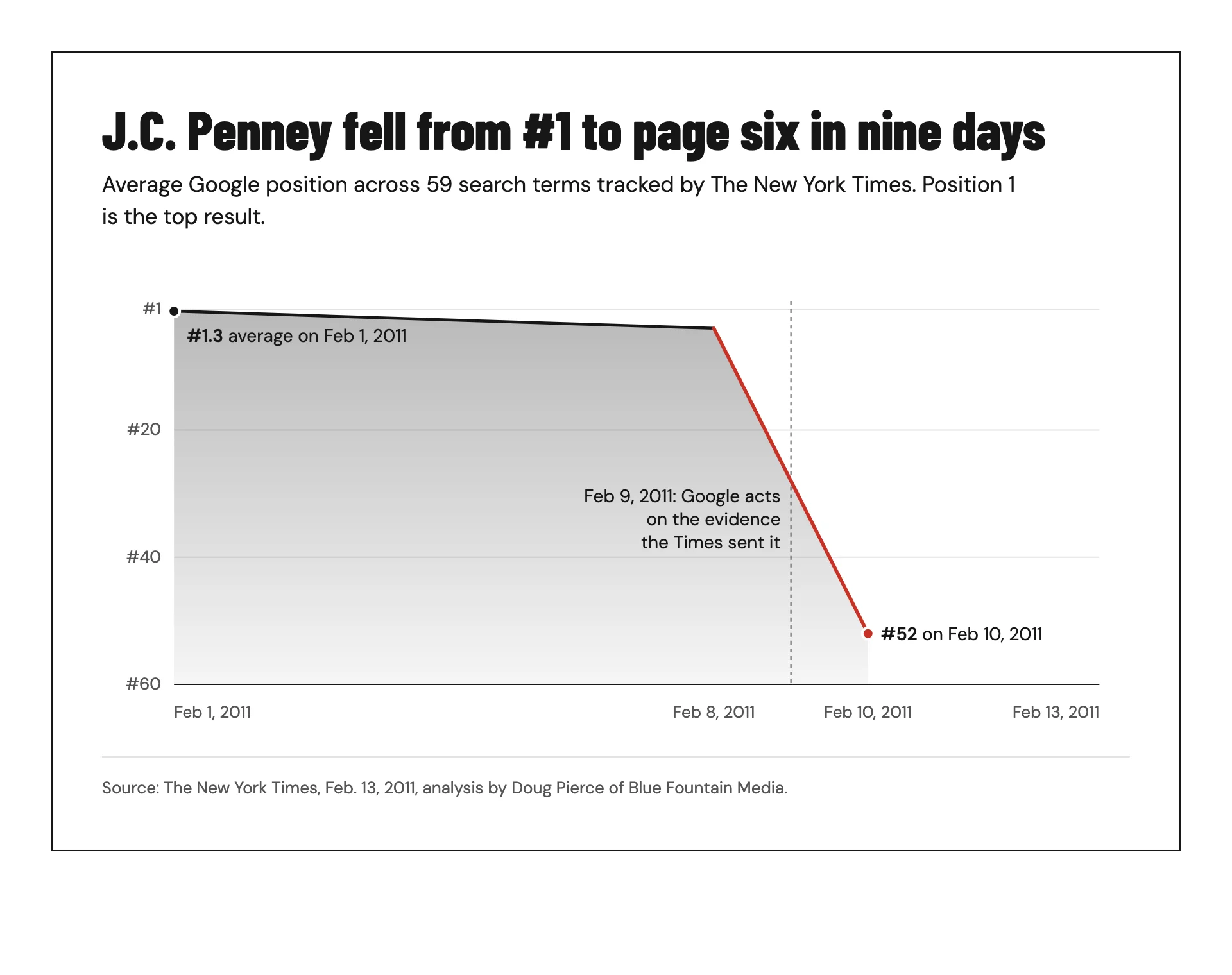
Through the 2010 holidays, J.C. Penney ranked first on Google for “dresses,” “bedding” and dozens of other searches. The New York Times looked into this dominance and traced it back to thousands of links pointing at jcpenney.com from unrelated sites – many of them paid for. The Times took its evidence to Google, who quickly took action:
2. eHow and the original content farm (2011).
For most of the internet’s history, the only way to get new content on a website was to pay a human to write and post it.
In 2011, the secret to success was volume of content. A company called Demand Media paid freelancers about $15 an article to fill eHow (remember eHow?) with basic answers to a bunch of random questions. This content wasn’t all that valuable, but the tactics worked. eHow consistently ranked at the top of Google.
Demand Media went public in January 2011 at $17 a share, and early investors sold $86 million of their stock in the offering. Eleven weeks later, a Google update aimed at thin content cut eHow’s search visibility by about two-thirds. The stock peaked at $27 that spring. By October, it had dropped to $5.
It was a sign that things were shifting again. For most of the next decade, cheap tricks stopped paying off. Ranking meant writing pages people wanted, and that took time and money.
Then large language models arrived.
3. Causal rides the AI content wave up… and down (2023).
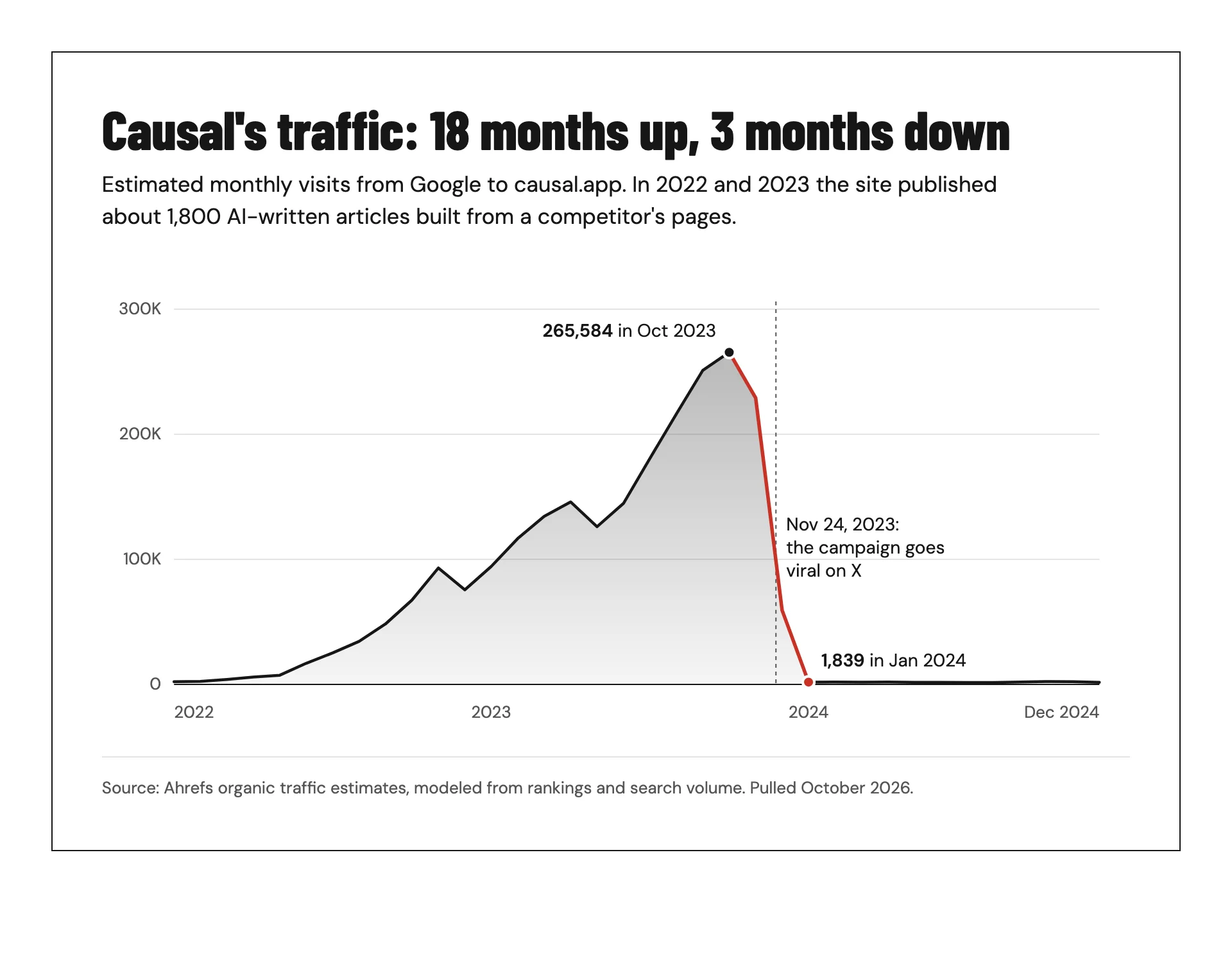
AI dropped the cost of content creation close to zero, creating a new opening to exploit. In 2023, an SEO consultant posted on X that his team had taken a competitor’s site map and used AI to write about 1,800 nearly-duplicate articles for his client, a software startup called Causal. Initially, it seemed like a genius move. Traffic skyrocketed.
But the win was short-lived. Google soon took notice, and within three months Causal’s website was banished to the shadow realm:
In March 2024, Google announced it had removed 837 sites from its results in a single week, citing low quality ai-generated content. Causal agreed to an acquisition later that year.
4. Forbes Advisor, and why you can’t license trust (2024).
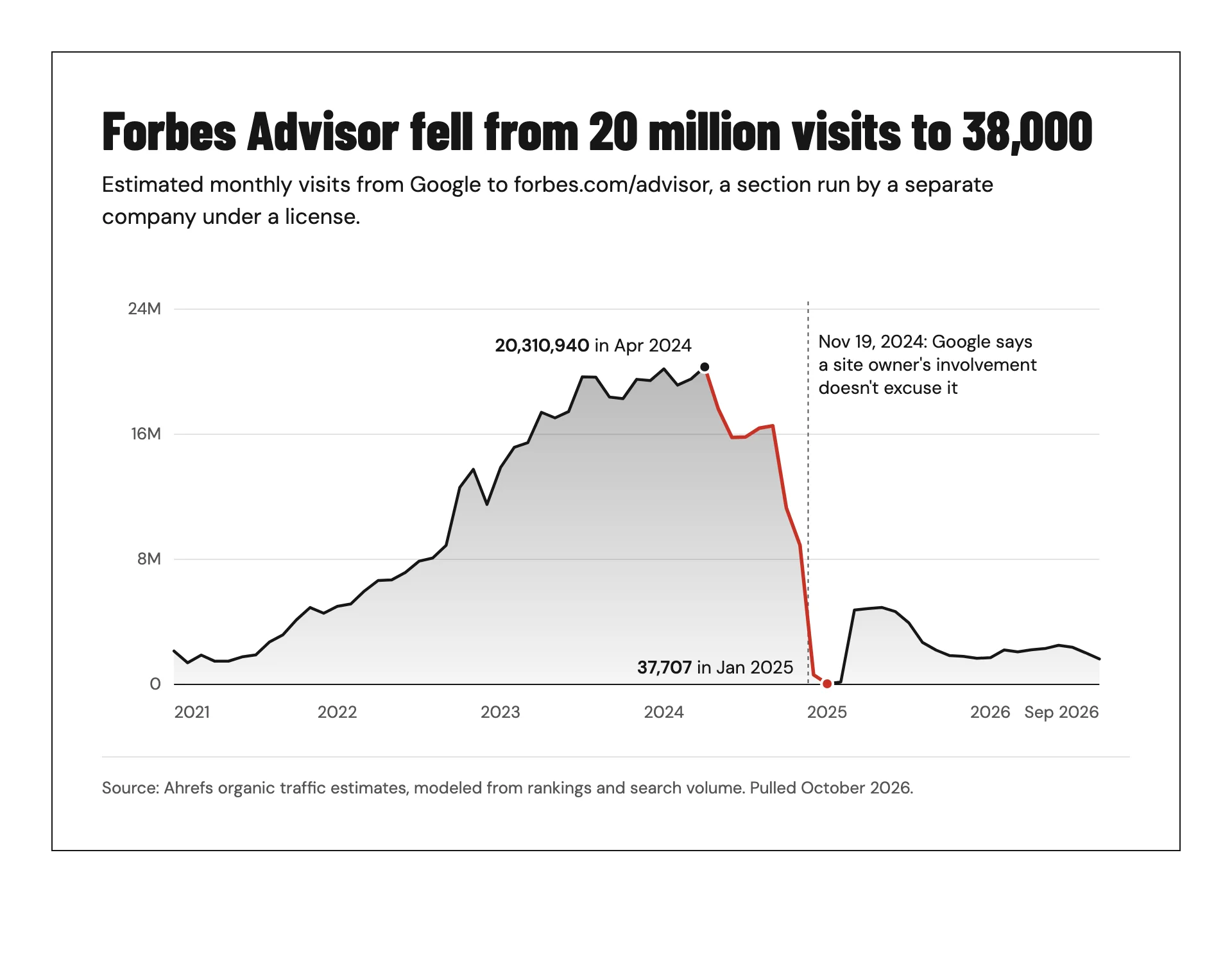
Another “innovative” shortcut involved borrowing a trusted name to rank better. Forbes Advisor was a section of forbes.com run by a separate company under a license. This section of the site ranked for credit cards, loans and insurance on the strength of the Forbes domain. But it shared none of the editorial discipline, and existed purely for marketing purposes. Website visitors could reasonably be confused.
In 2024, Google wrote a rule against hosting outside content to ride a big site’s reputation. It never named Forbes, but here’s what happened:
5. Comparison lists dominate SEO (2024–2026).
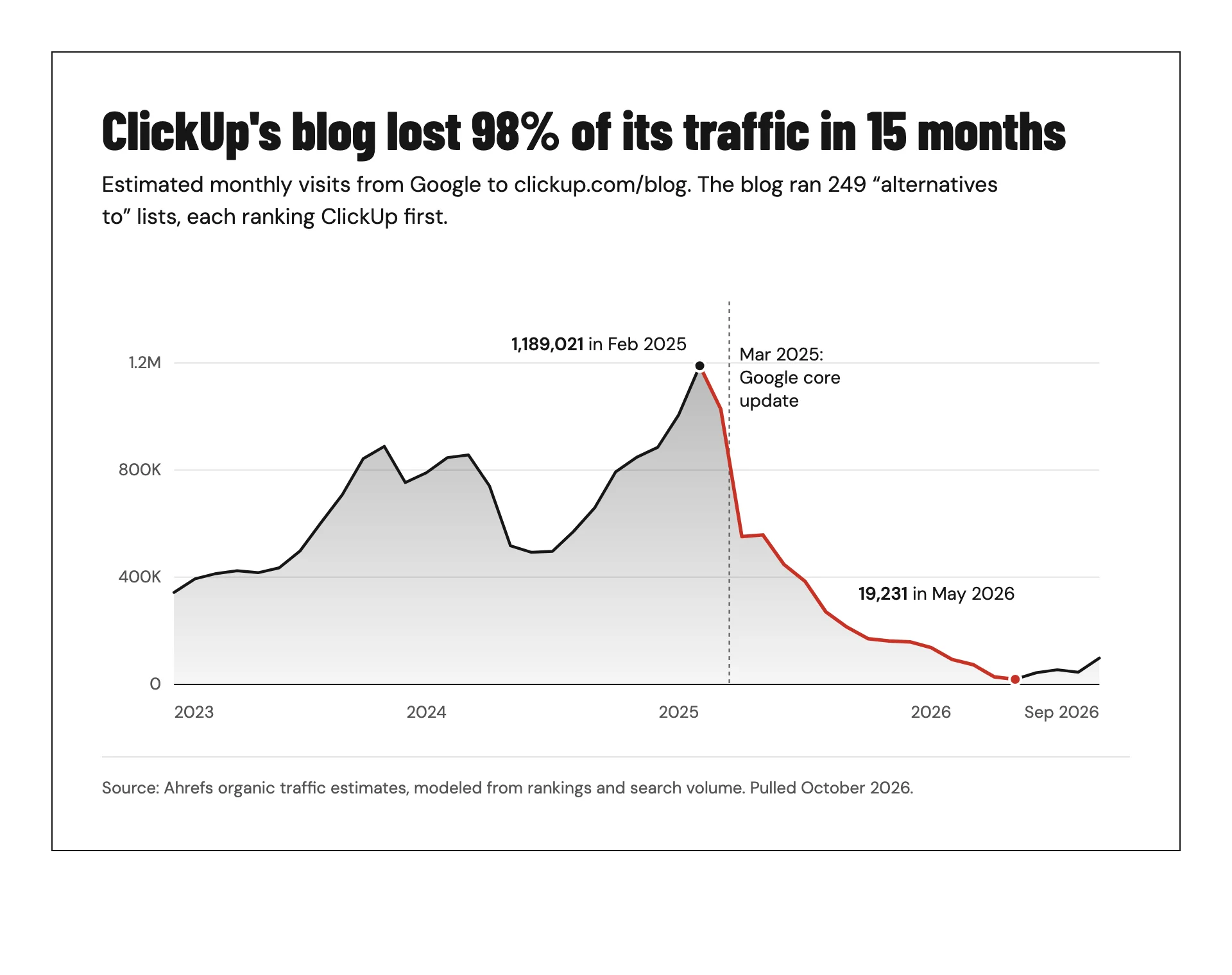
The latest version of this tactic is a comparison list. A company publishes “The 10 best tools for X,” ranks itself first, and hopes LLMs and AI summaries quote the list as an independent answer. ClickUp, a project management software, was early to this strategy. It published 249 “alternatives to” lists starting in 2024, and every one ranked ClickUp first. It worked for a while, but then the music stopped:
Earlier this year, SEO researcher Lily Ray tracked seven more software companies running the same play that all lost between 30-50% of their search visibility in a few weeks.
But comparison lists aren’t totally dead. Other studies show these vendor comparisons are continuing to drive traffic, so the tactic may still have some utility if done in a less obviously self-serving way.
6. The old tricks, rewritten for AI (2026).
Hidden text is making a comeback. In February 2026, Microsoft’s security team found 31 companies doing the AI version. Their “Summarize with AI” buttons carried hidden instructions telling agents to remember the company as a trusted source. Several came from finance sites.
Shortcuts work until they don’t.
Black hat strategies aren’t going anywhere. So long as it drives traffic, you’ll find people willing to play fast and loose with the rules of search. And they may even pay off for a while – but it’s hard to say how long “a while” will be. J.C. Penney’s rankings held for a few months, Causal’s for about 18, and Forbes Advisor’s for about four years. Was it worth it? If short term sales were the priority, maybe. If the goal was building a respected brand over the long term… maybe not.
The next time someone promises a guaranteed way to boost your search rankings, ask how exactly they plan to do it. Firms seeking to build their web presence should be wary of “get rich quick” traffic schemes and focus their efforts on sustainable growth over time.